Tongits Hand Combinations: The Complete Beginner-friendly Breakdown With Examples
If you are reading this article, you must have played Tongits at some point or the other in your life. We are all familiar with the 52 card deck and the many Tongits hand combinations that can be made. But what makes it a winning hand? This article will break down every major hand type and how it can change your strategy, especially if you're still new to understanding Tongits rules or figuring out how to play Tongits.
What Are Tongits Hand Combinations? (And Why They Matter)
The aim of the Tongits game is to make valid sets and sequences with the cards in your hand and those you pick up to make sure your score is zero. Now what are these valid sets and sequences aka hand combinations that decide whether you should play, drop, challenge or even win the game.
The idea is to master all these Tongits hand combinations and we have detailed out 9 for you to help you pivot your strategy at any time. You will learn to:
- Reduce the number of your unmatched cards quickly
- Build a low-point hand to reduce your scoring
- Read the playing styles of your opponents better
- Improve your chances in Tongits free play or real matches
By the time you finish reading this, you will be more well-versed on how to play Tongits and be equipped to handle any kind of meaningful combination that comes your way and have mastered important Tongits rules.
The 9 Types of Tongits Hand Combinations
Yes. There are this many Tongits hand combinations for you to know but they are easy to understand when you break down the strategy behind it. The higher you go in the number, the more strategic they become. These work on Tongits free play as well.
Below are all the combinations you need to know. These are the backbone of the Tongits game.
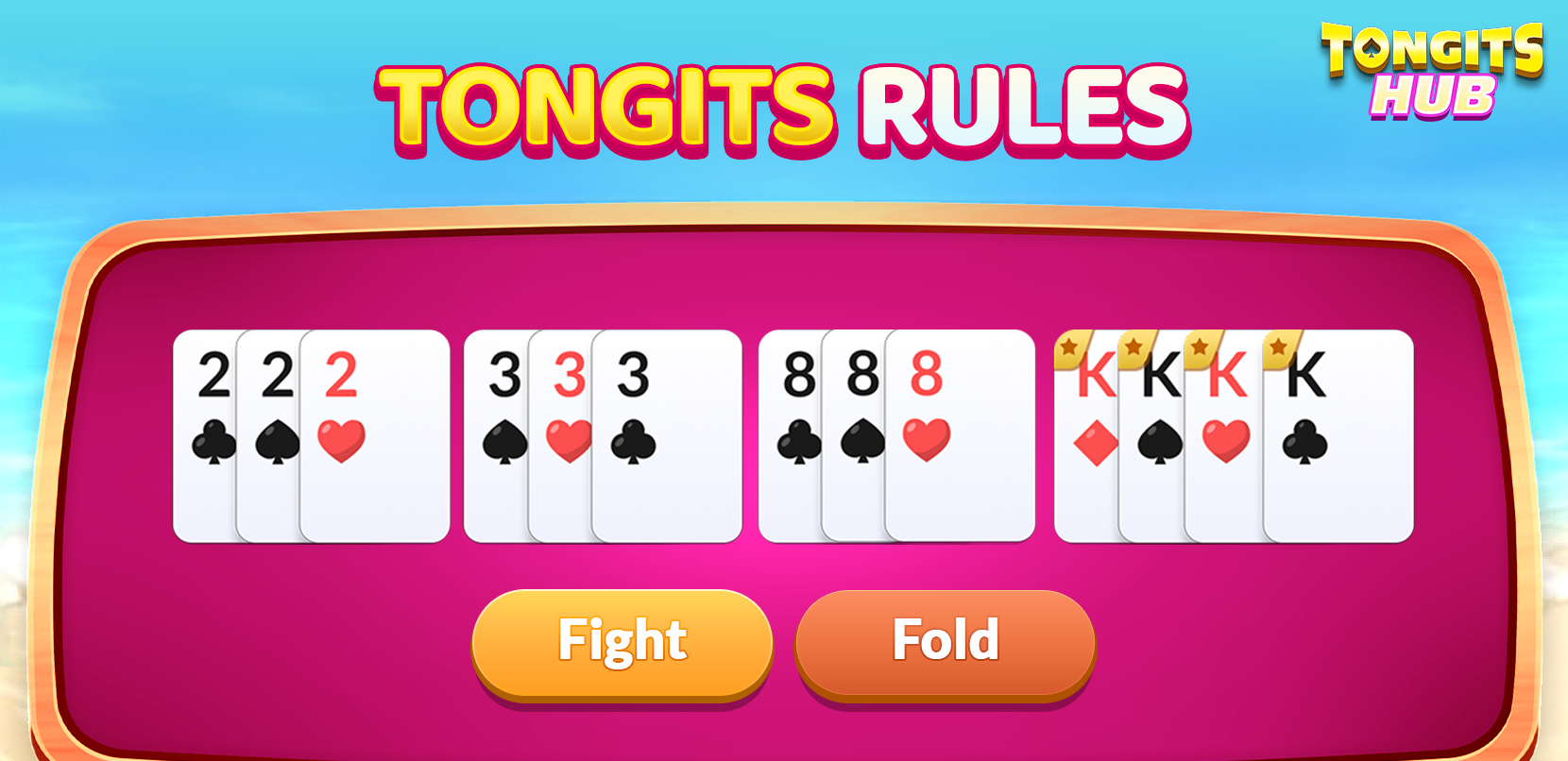
1. The Trio (Three-of-a-Kind)
This is exactly what the name suggests. It is three cards of the same rank and each card has a different suit. It is known as the simplest Tongits hand combinations and players have a high probability of achieving this.
Example: 7♣ 7♥ 7♠ or K♣ K♦ K♠
Why it's powerful: Once a Trio is formed, it is considered solid. No opponent's action can easily disturb it and you don't risk losing it unless you break it yourself. This falls under Tongits rules.
When to use it: If you can, form it early in the game. It saves you from getting burned and one of the most basic things you will learn about how to play Tongits. You can also use it when you are aiming for a low-point hand and when you think your straight is getting blocked since others on the table are hoarding that suit. This is where your observation skills come to play.
Strategic insight: If you're holding two matching cards (like 10♣ and 10♠), don't rush to discard one to chase a straight. The third 10 often appears in mid-game when more cards have circulated.
2. The Straight (Sequence)
We have all heard of this term, sequence. It basically implies when a card of the same suit is in consecutive order. The probability of making a straight is extremely high and can position yourself as a winner.
Example:
- Simple Straight: 4♦ 5♦ 6♦
- Expandable Straight: 5♥ → 6♥ 7♥ → 8♥
Why it's powerful: Tongits game leans heavily on flexibility and sequences/straight can grow or shrink based on what happens in the game according to Tongits rules. Let's explain it with the example of the expandable straight shown above. If you have 6♥ and 7♥, then you have two ways to complete it. You can either complete it with 5♥ (lower) or 8♥ (higher).
When to use it: If you have two consecutive same-suit cards to double your probability of success. You can also use it when making a connection through dropped or melded cards. You can also use it when a suit is flowing i.e. when other players are discarding the same suit.
Strategic insight: It is your most versatile edge on how to play Tongits game and you should break a sequence later in the game. Hold them a bit longer if you see the suit circulating among players.
3. Four-of-a-Kind
Now this one is like finding gold. You know it exists and you want to find it, but it requires a lot of patience and a factor of luck. Maybe that's why a Four-of-a-kind is known as the "royal armor" of Tongits hands.
Example: 3♣ 3♦ 3♥ 3♠ or A♣ A♦ A♥ A♠
Why it's powerful: It is the most rare Tongits hand combination you can make. It also has extremely low points and irrespective of what's happening in the game flow, it can't be weakened. Moreover, it gives you a huge leverage if there is a draw.
When to use it: If you sense the Tongits game heading toward a "challenge" or a "draw," having a Four-of-a-Kind dramatically lowers your total. This becomes even more important if you have unmatched cards.
Strategic insight: If you are just learning how to play Tongits, remember that the key is to never discard a card that could form a Four-of-a-Kind. The only exception is if it's a high-value risk (like a face card) and you already have too many high cards.
4. Extended Sequence (4+ Card Straight)
In Tongits hand combinations, this is like cherry on a cake. Just adds more fun to Tongits game. It's like a chain of cards that make longer straights. It's considered the backbone of fast Tongits wins.
Example: 4♣ 5♣ 6♣ 7♣ 8♣
Why it's powerful: It helps you to eliminate multiple cards at once and reduce your dependency on draws. It also helps you with strong structures for safe drops.
When to use it: This combination usually appears mid Tongits game. Watch for opportunities when someone drops adjacent cards. No Tongits rules states that you can't do that.
Strategic insight: There is a trap you can fall into with extended sequence and it is applicable in Tongits free play as well. You can hold them and overprotect your long straights. Sometimes it is more strategic to break a long straight to create two workable 3-card sequences which can give lower final points.
5. Pure Melds (All Sequence/Straight or All Trio Hand)
This is the dream hand for Tongits lovers where every single card you hold is part of a valid Trio or Straight. There are no loose cards as per Tongits rules.
Example:
- Straight 1: 4♣ 5♣ 6♣ 7♣
- Straight 2: 9♥ 10♥ J♥
- Trio 1: 2♦ 2♣ 2♠
- Trio 2: K♠ K♥ K♦
Why it's powerful: This is the strongest defensive hand in the entire Tongits game. You can drop early with confidence, avoid losing by burn or draw and can chase a Tongits win aggressively. Moreover, your total points remain extremely low.
When to use it: Some players aim for a completely melded hand where everything is a part of a valid combination.
Strategic insight: This Tongits hand combinations is usually formed through early straights and mid game trios which means that you need to have a low point strategy from the start. Another key is to avoid high-risk sequences.
6. Mixed Melds
Now this Tongits hand combinations is the most common to have as it is a mix of Trio and Straight. You'll see this in 70–80% of matches. But while a common phenomenon, it helps you to have a flexible strategy.
Example:
- Straight 1: 3♦ 4♦ 5♦
- Straight 2: J♣ Q♣ K♣
- Trio 1: 9♠ 9♥ 9♦
Why it's powerful: The beauty of this hand is that it allows you to find multiple ways of extending the meld. It gives protection from challenges and has a strong drop safety. What's more, it also keeps your point total in the low to moderate range.
When to use it: This meld is so versatile that you can use it in any situation. It adapts to unpredictable tables including Tongits free play. If someone blocks your Straight, your Trio still gives stability.
Strategic insight: This hand will save you from most situations and gives an agile strategist more room to play. This is what makes Tongits game so strategic to play.
7. Potential or "Open" Sequences
This hand isn't complete, yet. They are incomplete Tongits hand combinations that need one card to be valid. But this is a solid foundation to have during mid-game.
Example:
- 8♦ 9♦ (arrows pointing to 7♦ and 10♦)
- 6♦ 7♦ (arrow pointing to 5♦ or 8♦)
Why it's powerful: These pairs create ways for your hand to expand. Even when incomplete, they give you directions and guide you on what you keep and what to discard.
When to use it: This is the key to help you plan your gameplay and how to play Tongits. If you hold two connected cards, avoid discarding them unless the point pressure gets high. Use it during mid-game for best results.
Strategic insight: These sequences become deadly when you keep an eye on what your opponents discard or keep. You can control the game when you control this aspect of it.
8. The Final Tongits Hand (Zero Cards Left)
It is an amazing feeling when you finish the game and win with a hand that doesn't need a drop. This is a rare one and something all Tongits game lovers aim for.
Example:
- Straight 1: 3♣ 4♣ 5♣
- Straight 2: 7♦ 8♦ 9♦
- Trio: Q♠ Q♥ Q♦
- One final discard: K♣
Why it's powerful: All your cards have merged into combinations with zero loose cards. You just discard one final card to win or you connect the last card to an already existing meld. Efficiency at its best while taking care of all Tongits rules.
When to use it: This is a rare situation and can only be used if you have a sharp memory, have good defensive discards and efficient combination planning. Also, a little mid-game luck goes a long way in Tongits free play.
Strategic insight: In terms of chess, another heavy strategy game, this is called checkmate. This is the epitome of what it means that you need the right timing and not brute force.
9. Draw-Optimized Low-Point Hand
Sometimes you don't aim to win with Tongits. You aim to win by outscoring everyone during a draw.
Example:
Winner with Low Points:
- Straight 1: 3♣ 4♣ 5♣
- Trio: 6♥ 6♣ 6♦
- Straight 2: 2♠ 4♥ 5♦
Loser with High Points:
- Straight 1: J♦ Q♦ K♦
- Loose Cards: 10♠, Q♣, K♥
Why it's powerful: While it doesn't look flashy, it is highly effective. This Tongits hand combinations has no queens, kings or jacks but is filled with low-value cards (2–6 range), which means that your points will always be low in case of a draw.
When to use it: If someone calls a draw, you often win by having a lower total points, fewer high cards and stronger confirmed combinations.
Strategic insight: Beginners underestimate draw wins, but experienced players use them as a safety net.
Putting Together the Perfect Tongits Hand
Here is a decision making flow chart to understand it better.
Step 1: In this example, when you're evaluating your Tongits hand combinations, start by checking whether you already have any solid Trios. If you do, meld them early because they give your hand instant stability.
Step 2: Next, look for potential Straights, even incomplete ones. These "open" sequences are valuable, so hold onto them while watching what other players discard. You can use this in Tongits free play as well.
Step 3: After that, scan your hand for high cards such as queens, kings, jacks, or tens. If they don't fit into any combination, discard them before they inflate your points as we all know from Tongits rules.
Step 4: Once that's done, take a moment to assess your total points which you would have learned during how to play Tongits. If your points are on the higher side, shift your focus toward lowering them quickly. If they're already low, you can afford to protect your structure and play more deliberately.
Step 5: With this quick mental checklist, you can decide whether to play aggressively or defensively, positioning yourself for a smart draw victory.
Quick Decision Making Chart:
-
Evaluate Your Hand → Check for any Trios?
- ✔ Yes → Meld them early
- ✘ No → Continue to next step
-
Any Potential Straights?
- ✔ Yes → Hold them & watch the table
- ✘ No → Proceed
-
High Cards to Drop?
- ✔ Yes → Discard safely
- ✘ No → Continue
-
Points Check?
- High points → Prioritize discarding
- Low points → Hold structure, prepare for drops
- Unsure → Watch opponents' discards
-
Decide: Play Aggressive or Defensive?