Tongits Scoring Guide: Complete Points System & Calculation Explained
Understanding the Tongits scoring system is crucial for winning consistently. This comprehensive guide breaks down every aspect of the points calculation in Tongits - from basic card values to advanced scoring scenarios like Burn penalties and Challenge outcomes.
Whether you're a beginner learning how to calculate points or an experienced player looking to refine your understanding, this guide covers everything you need to know about Tongits scoring.
Understanding Basic Card Values in Tongits
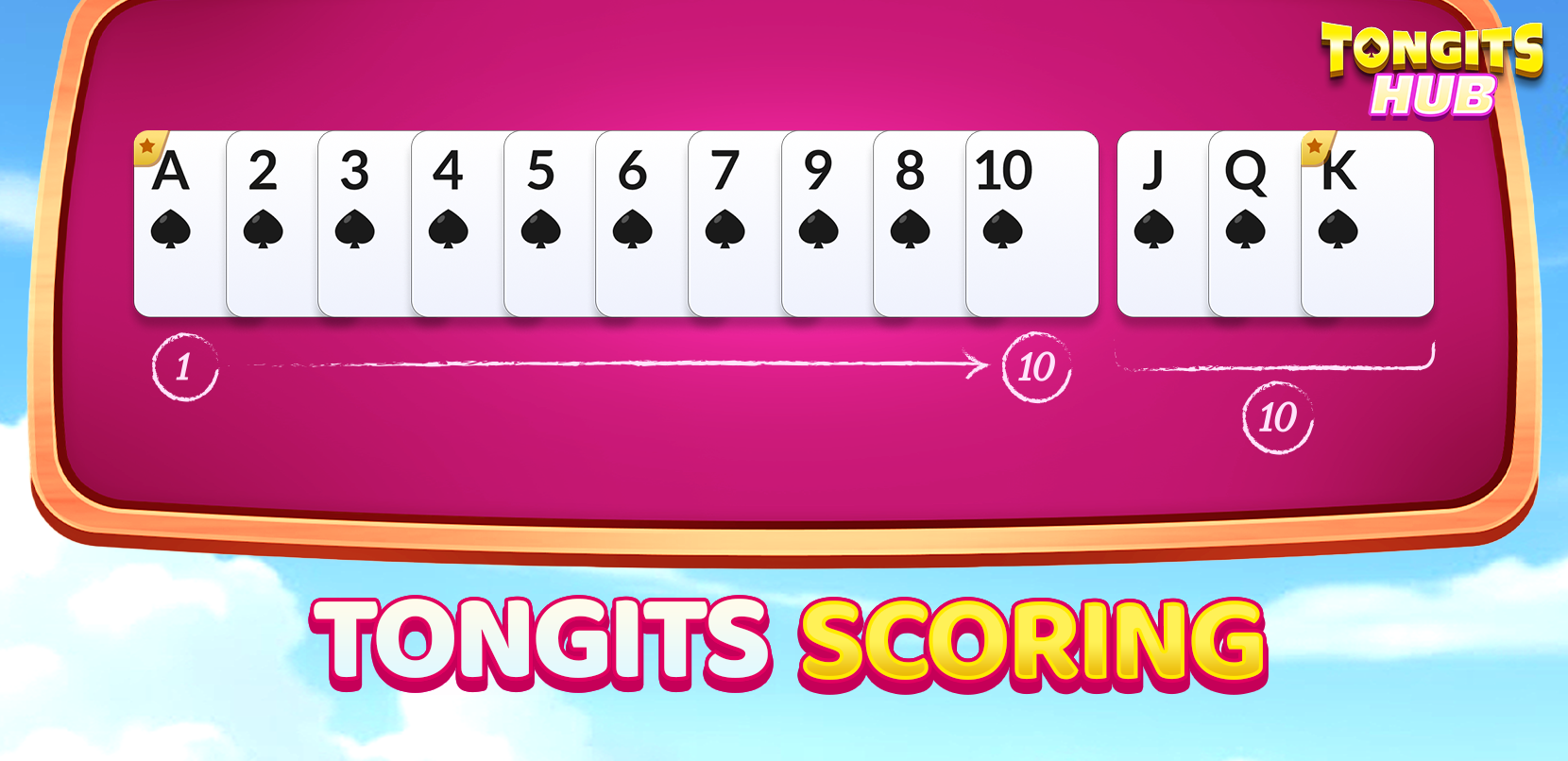
The foundation of Tongits scoring starts with knowing the value of each card. Unlike some card games where suits matter for scoring, in Tongits, only the rank determines the point value.
Standard Card Values
| Card Type | Point Value | Examples |
|---|---|---|
| Ace (A) | 1 point | A♠ = 1, A♥ = 1, A♦ = 1, A♣ = 1 |
| Number cards (2-10) | Face value | 2♥ = 2, 5♦ = 5, 9♠ = 9, 10♣ = 10 |
| Face cards (J, Q, K) | 10 points each | J♥ = 10, Q♦ = 10, K♠ = 10 |
Important Scoring Rules
- Suits don't affect points: A King of Hearts has the same value (10 points) as a King of Spades
- Aces are always low: In Tongits, Aces are worth only 1 point and cannot be used in high sequences like Q-K-A
- Melded cards don't count: Once you expose a Meld on the table, those cards are no longer counted toward your point total
- Sapaw cards are gone: When you lay off (Sapaw) cards onto opponents' Melds, those cards also stop counting toward your points
How Points are Calculated in Tongits
When a round ends, whether by someone calling "Tongits," a Challenge, or the draw pile running out, you calculate your score by adding up all the unmelded cards remaining in your hand.
Step-by-Step Point Calculation
Let's walk through an example to make this crystal clear:
Example Hand at Round End:
- Exposed Melds on table: K♠ K♥ K♦ (Set of Kings)
- Exposed Melds on table: 4♣ 5♣ 6♣ (Run of Clubs)
- Cards still in hand: Q♥, 9♦, 2♠
Calculation:
Exposed Melds: 0 points (these don't count)
Q♥: 10 points
9♦: 9 points
2♠: 2 points
---
Total Score: 21 points
Common Calculation Mistakes to Avoid
- Don't count exposed Melds: A frequent beginner mistake is counting the cards you've laid down on the table. Remember: only cards still in your hand count
- Don't forget Sapaw cards: If you laid off a J♥ onto an opponent's Meld, that card is no longer in your hand and doesn't count toward your score
- Calculate before Challenging: Always know your exact point total before calling Challenge. Miscalculating can lead to embarrassing and costly losses
Scoring in Different Win Scenarios
The way points are awarded or penalized depends on how the round ends. Let's examine each scenario:
1. Winning by Calling "Tongits"
This is the most decisive victory in the game.
Requirements:
- You've used all your cards in valid Melds and Sapaws
- You discard your final card
Scoring:
- Winner: Receives payments from all opponents based on their point totals
- Losers: Pay based on their remaining unmelded points
- Typical payout: Each loser pays the winner according to the agreed bet multiplied by their points (specific betting rules vary by game variant)
Example:
- Player 1 calls "Tongits" (0 points)
- Player 2 has 15 points
- Player 3 has 23 points
- If the bet is 1 unit per point, Player 1 wins 38 units total (15 + 23)
2. Winning by Challenge
When you call Challenge and have the lowest points among all players who Fight:
Scoring:
- Winner: Receives payments from all players who had higher points
- Losers: Pay the winner based on the point difference
- Penalty multiplier: Losing a Challenge often carries a 2x or 3x multiplier on the point difference (depends on house rules)
Example:
- Player 1 Challenges with 8 points
- Player 2 Folds
- Player 3 Fights with 14 points
- Player 1 wins by 6 points
- With 2x Challenge multiplier: Player 3 pays Player 1 for 12 points (6 × 2)
3. Losing a Challenge
If you call Challenge but don't have the lowest points:
Scoring:
- Challenger (you): Pays the actual winner with penalty multiplier
- Winner: Receives payments from the failed challenger
- Typical penalty: 2x to 3x the point difference (harsh punishment for failed Challenges)
This is why you should only Challenge when you're confident you have the lowest points!
4. Draw Pile Runs Out
When the Closed Pile is exhausted with no winner:
Scoring:
- Player with the lowest points wins
- Payment is typically based on standard point differences
- Players with no exposed Melds get Burnt (see next section)
Burn (Sunog) Penalty Scoring
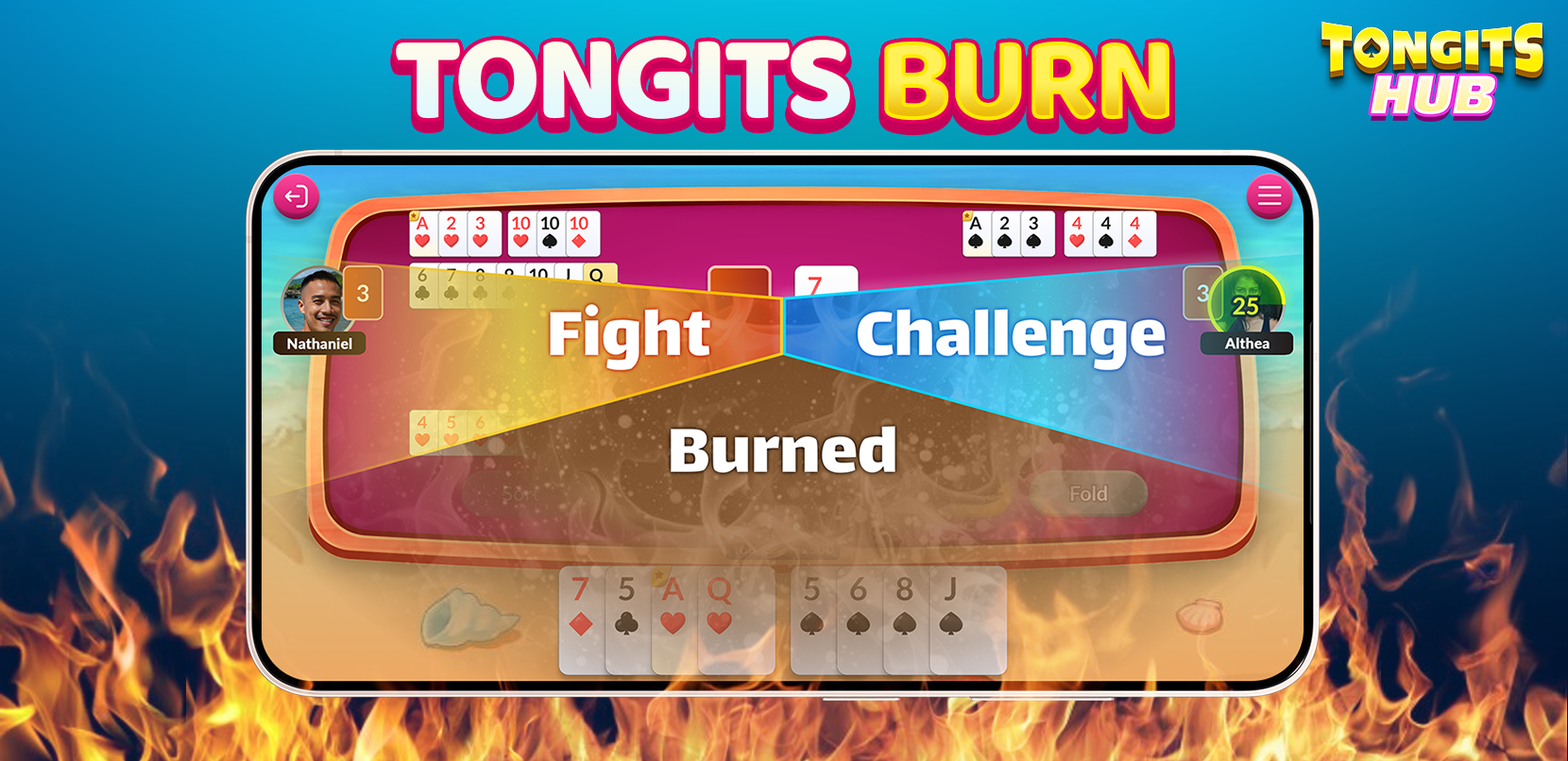
Getting Burnt (Sunog) is the harshest penalty in Tongits.
When You Get Burnt
You receive the Burn penalty when:
- The round ends (by any method)
- You have zero exposed Melds on the table
- Even if your hand has low points, you automatically lose
Burn Penalty Amounts
The Burn penalty varies by game variant:
- Double points variant: Your current hand points are doubled
- Fixed penalty variant: You pay a fixed amount (commonly 50 points or the equivalent in the betting structure)
- Maximum penalty variant: You pay the maximum possible points (commonly 100 points)
Example: Burn Penalty in Action
Scenario:
- Player 1 calls "Tongits"
- Player 2 has 12 points with 2 exposed Melds (safe)
- Player 3 has only 9 points but NO exposed Melds
Result:
- Player 3 gets Burnt despite having lower points than Player 2
- With double penalty: Player 3 pays 18 points (9 × 2)
- Player 2 pays only 12 points
This example shows why having at least one exposed Meld is crucial, even if you're holding low-value cards!
Challenge and Fight Point Calculations
Understanding Challenge scoring is essential for advanced play.
Challenge Point Differentials
When players Fight in a Challenge, the winner receives points based on the difference:
Standard Calculation:
Winner receives: (Loser's Points - Winner's Points) × Multiplier
Challenge Multipliers by Scenario
Different variants and house rules use different multipliers:
| Scenario | Common Multiplier | Example |
|---|---|---|
| Standard Challenge win | 1x to 2x | 10 point difference = 10-20 points paid |
| Failed Challenge (you called but lost) | 2x to 3x | 10 point difference = 20-30 points paid |
| Opponent was Burnt | 3x to 5x | 10 point difference = 30-50 points paid |
| Winning by "Tongits" | 2x to 3x | Opponent's points × 2 or 3 |
Always clarify the multipliers before starting a game, especially when playing for money!
Example: Complex Challenge Scenario
Situation:
- Player 1 calls Challenge with 6 points
- Player 2 Folds immediately
- Player 3 Fights with 11 points
- Multiplier is 2x for Challenge wins
Calculation:
- Point difference: 11 - 6 = 5 points
- With 2x multiplier: 5 × 2 = 10 points
- Player 1 wins 10 points from Player 3
- Player 2 (who Folded) typically pays a small fixed penalty, like 5 points
Advanced Scoring Strategies
Now that you understand the basic Tongits scoring system, let's explore strategic implications:
1. Target Single-Digit Points
Professional players aim to keep their score under 10 at all times:
- Discard face cards (10 points each) as quickly as possible
- Prioritize Sapaw opportunities to reduce points
- Create quick short Melds rather than waiting for perfect long ones
2. The "Safety Meld" Strategy
Always expose at least one Meld early to avoid Burn penalties:
- Even a simple 3-card Set protects you from the worst outcome
- You can expand this Meld later or use it as a base for Sapaw
- The safety Meld makes you Challenge-eligible
3. Calculate Opponent Points
Track discards and visible Melds to estimate opponent scores:
- If an opponent discards all their face cards, they likely have low points
- Opponents with few exposed Melds might have higher points
- Use this information to time your Challenge optimally
4. Risk-Reward of Various Plays
Understand the scoring implications of each decision:
Example Decision:
- You hold J♦ Q♦ and need K♦ for a Run
- Current points in hand: 23
- Should you wait or discard the face cards?
Scoring Analysis:
- Keeping J♦ Q♦: Risk = high (20 points if round ends)
- Discarding both: Immediate benefit = 20 points reduction
- Best play: Discard unless the deck is thick and you have other low cards
5. Fold vs Fight Mathematics
When someone Challenges, make a mathematical decision:
Fold when:
- Your points are 5+ higher than your estimate of the challenger's points
- The penalty for losing a Fight exceeds the Fold penalty
- You have no information and want to minimize risk
Fight when:
- Your points are competitive (within 3-5 points of your estimate)
- You've been tracking cards and believe you can win
- You're behind in the overall game and need to take risks
Conclusion: Mastering Tongits Scoring
Understanding the Tongits scoring system transforms you from a casual player into a strategic competitor. Remember these key principles:
- Lower is always better: Every decision should aim to reduce your point total
- Protect against Burn: Always have at least one exposed Meld
- Know before you Challenge: Calculate your exact points before initiating a Challenge
- Understand multipliers: Know your game's specific penalty and reward multipliers
- Track opponent scores: Use visible information to make better Strategic decisions
With this comprehensive understanding of Tongits scoring, you're now equipped to make informed decisions, avoid costly mistakes, and maximize your winnings. Practice calculating quickly, and soon scoring will become second nature!