Tongits Lingo Explained: 15 Essential Filipino Card Game Terms
Most Tongits guides explain the rules. Very few explain the language players actually use while playing.
Sit at a real Tongits table and you will notice something quickly. Players rarely explain things in long sentences. Instead, they communicate with quick words:
"Sapaw." "Sunog ka." "Laban?"
These short phrases carry a lot of meaning. They signal strategy, risk, and sometimes even bluffing. If you do not understand them, you might still follow the cards but miss half of what is happening in the game.
Learning Tongits lingo helps you:
- Understand conversations at the table
- Recognize important moments in the round
- Play more confidently against experienced players
Below are 15 commonly used Tongits terms every player should know, along with simple examples so that you can recognize them instantly during a match.
If you want to see these terms used in real games, many players now practice and learn Tongits through mobile play. Download apps like TongitsHub to discover more.
Why Tongits Has Its Own Vocabulary
Tongits developed as a community card game in the Philippines, often played in homes, street corners, and small gatherings.
Because of this social setting, players created quick shorthand expressions to describe gameplay situations.
Instead of saying:
"Your unmatched cards have the highest value."
Players simply say:
"Sunog."
These words make the game faster, more social, and easier to follow once you know what they mean.
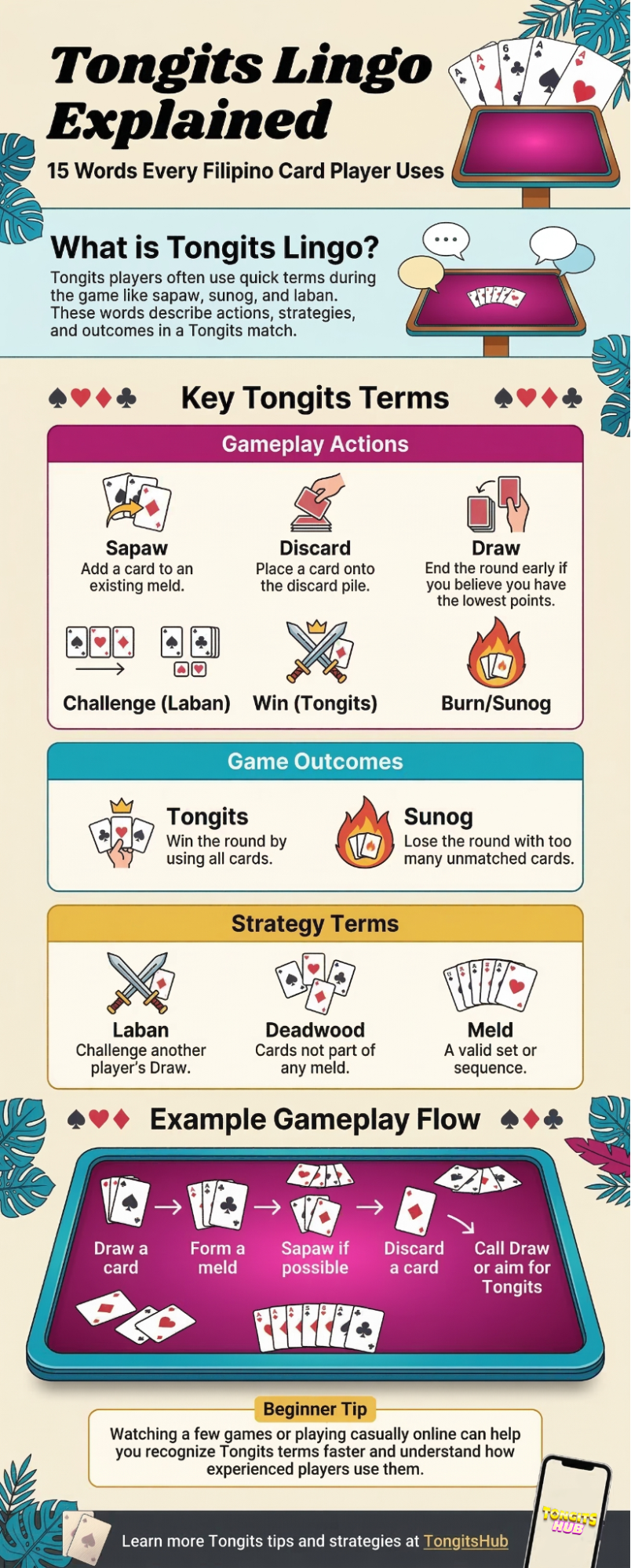
Quick Overview of Common Tongits Terms
| Term | Meaning | When It Happens |
|---|---|---|
| Sapaw | Adding a card to an existing meld | During your turn |
| Sunog | Losing with high unmatched cards | End of round |
| Laban | Challenging a Draw call | When another player calls Draw |
| Draw | Ending the round early | When a player believes they have the lowest points |
| Tongits | Winning by emptying your hand | Immediate win |
| Meld | A valid set or sequence | During gameplay |
| Deadwood | Unmatched cards in hand | Used for scoring |
| Burn Card | First card of discard pile | Start of game |
| Discard | Card placed on discard pile | End of every turn |
| Deck | Stack of cards players draw from | Throughout the round |
| Sequence | Consecutive cards of same suit | Meld type |
| Set | Same rank cards | Meld type |
| Challenge | Accepting a Draw call | During Draw |
| Fold | Refusing to challenge Draw | During Draw |
| Round | One full game cycle | Game session |
1. Sapaw
Sapaw means adding a card to a meld already placed on the table.
Melds can be either:
- a set (same rank)
- a sequence (same suit in order)
Example
A player lays down:
- 6♠
- 7♠
- 8♠
Another player holding 9♠ may place it onto the sequence.
That move is called Sapaw.
Sapaw is useful because it lets you reduce cards without creating your own meld.
2. Sunog
Sunog means a player loses with too many unmatched cards.
It happens when the round ends and the player's cards cannot form valid combinations.
Example
A player ends the round with:
- K♦
- 8♠
- 4♣
None form sets or sequences.
That player is Sunog.
3. Laban
Laban means to challenge another player's Draw.
If you believe your hand has fewer deadwood points, you may challenge.
Example
Player A calls Draw.
Player B says Laban.
Both reveal cards and compare points.
The lowest score wins.
4. Draw
A player calls Draw when they believe they have the lowest deadwood total and want to end the round.
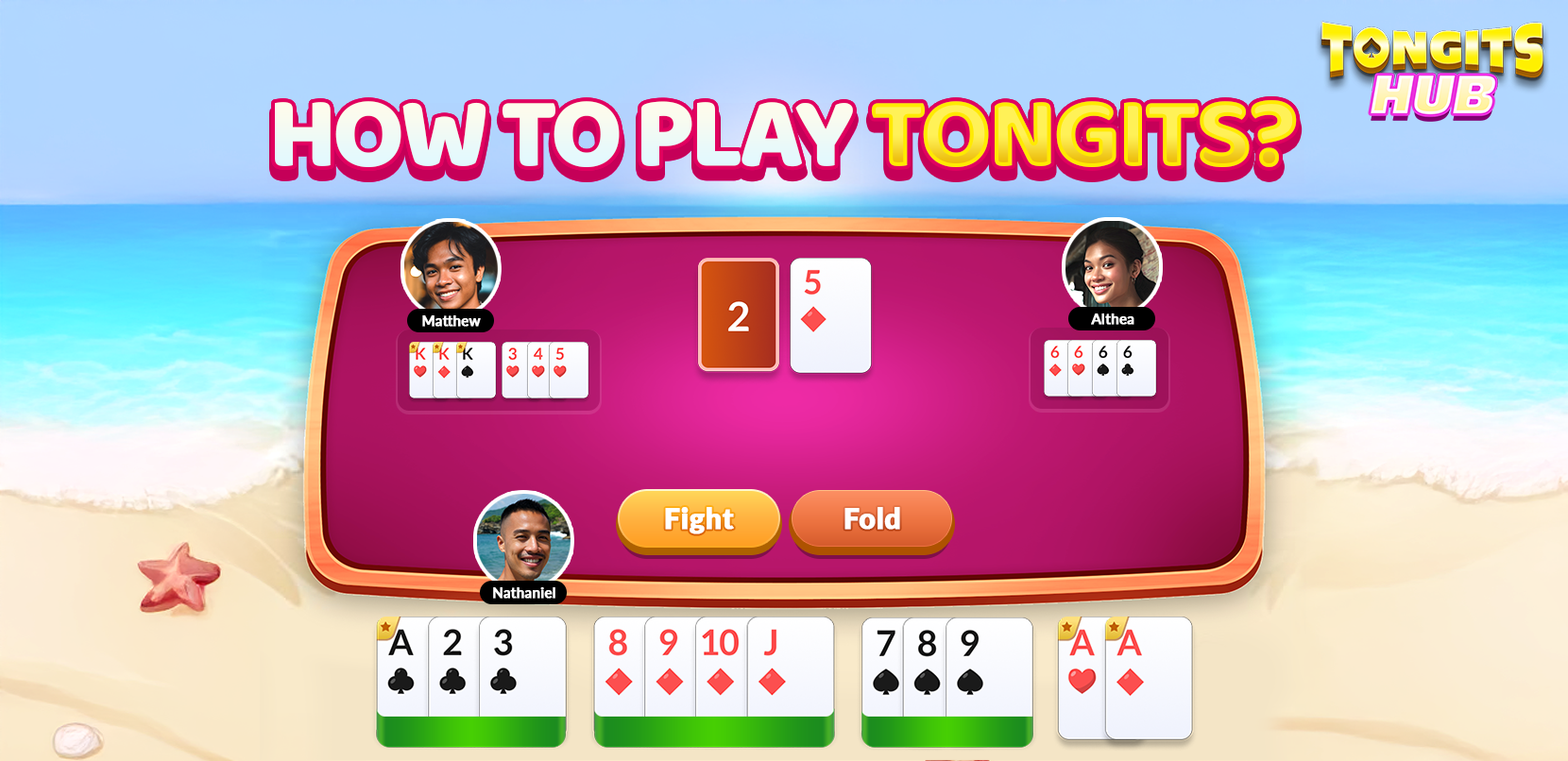
Other players can either:
- Challenge (Laban)
- Or Fold
Example
You have only 3 deadwood points left.
You call Draw before someone declares Tongits.
5. Tongits
A player wins by declaring Tongits when they successfully use all cards in their hand.
Example
You place your last card onto an existing meld.
You now have zero cards left.
You declare Tongits, winning the round immediately.
Many beginners understand Tongits faster by watching real matches. Playing a few rounds in apps like TongitsHub can help you recognize these moments quickly.
6. Meld
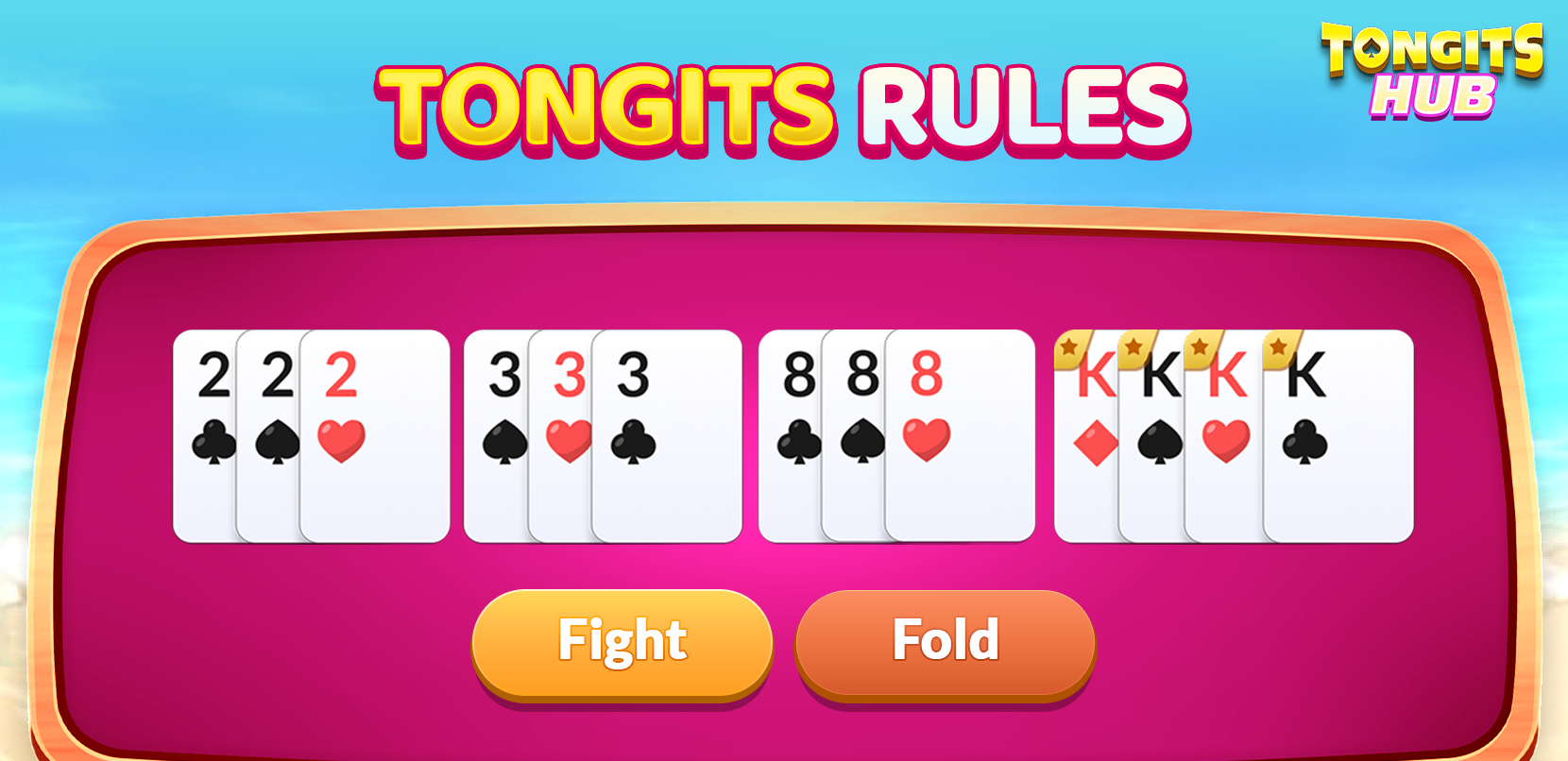
A meld is a valid card combination placed on the table.
Two types of melds exist.
Set
Cards with the same rank.
Example:
- 8♣
- 8♦
- 8♠
Sequence
Cards in order and same suit.
Example:
- 4♥
- 5♥
- 6♥
7. Deadwood
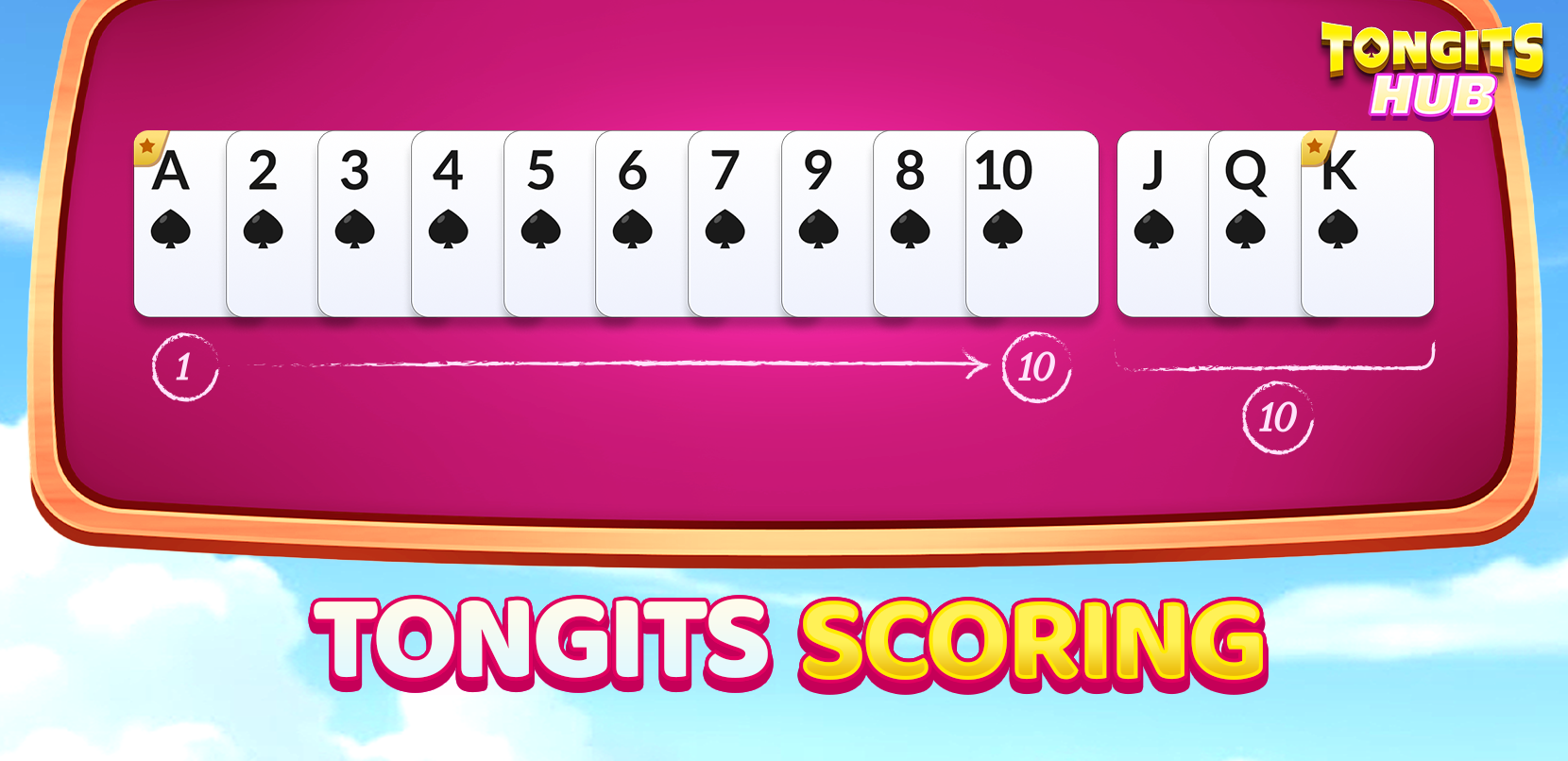
Deadwood refers to cards that do not belong to any meld.
These cards determine scoring when the round ends.
Example
Remaining cards:
- A♦
- J♠
These count as deadwood points.
8. Burn Card
The burn card is the first card placed face-up to start the discard pile.
Example
If the Burn card is 10♣, it becomes the starting card of the discard stack.
9. Discard
Every turn ends with a discard.
Players must place one card onto the discard pile.
Example
You draw Q♠ but it does not help your hand.
You discard it.
Discard decisions influence opponents' strategies.
10. Deck
The deck is the remaining pile of cards players draw from.
Tongits uses a standard 52-card deck.
Players draw from the deck when they cannot use the discard pile.
11. Sequence
A sequence is a run of cards in the same suit.
Example:
- 5♦
- 6♦
- 7♦
Sequences help players form melds quickly.
12. Set
A set contains three or four cards with the same rank.
Example:
- Q♠
- Q♦
- Q♣
13. Challenge
A challenge occurs when a player responds to Draw with Laban.
Both players reveal cards.
The player with the lowest deadwood wins.
14. Fold
If a player believes their hand will lose against a Draw caller, they may fold instead of challenging.
Folding means accepting defeat for that round.
15. Round
A round refers to one full cycle of the game.
A round ends when:
- Someone declares Tongits, or
- A Draw is resolved.
Why Learning Tongits Lingo Makes You a Better Player
Knowing the vocabulary helps you read the table faster.
Experienced players often signal key moments through these terms.
For example:
| Situation | What It Signals |
|---|---|
| Player calls Draw | Round may end soon |
| Player says Laban | Challenge incoming |
| Sapaw opportunity | Chance to reduce cards |
| Risk of Sunog | High penalty risk |
Once you understand the language, the game becomes much easier to follow and more strategic.
Many players sharpen these instincts by playing multiple rounds online. Apps like TongitsHub allow you to play these scenarios and see how experienced players react in real matches.
Final Thoughts: The Real Language of Tongits
Tongits is not just about cards. It is about reading people, timing your moves, and understanding the flow of the table.
The vocabulary players use, words like Sapaw, Sunog, and Laban, evolved naturally from decades of gameplay across Filipino communities.
Once you start recognizing these terms, you will notice something interesting.
The game suddenly feels faster, clearer, and more strategic.
And the next time someone quietly says "Sapaw", you will know exactly what opportunity just appeared on the table.
If you want to see these moves play out in real games and practice them yourself, many players now learn by playing a few rounds online before joining live tables.